
We read ingredient labels. We choose organic produce. We filter our water.
We have learned to be intentional with what we put into our bodies.
But there is one daily choice that rarely gets the same care, despite being in constant contact with the most delicate, absorbent skin on the body:
Our underwear.
For decades, underwear has been framed as purely aesthetic or functional; lace for beauty, seamless stretch for movement. But science is gently asking us to look deeper. Not at how underwear looks, but at how it behaves against the body, hour after hour.
Because fabric is not passive.
It creates an environment.
And that environment matters.
1. When Fabric Traps Heat, the Body Responds
Most modern underwear is made from synthetic fibers like polyester, nylon, and spandex. These materials are hydrophobic, meaning they repel water. In activewear, this is often marketed as “moisture-wicking.” In intimate wear, it can have the opposite effect.
When moisture and heat are unable to escape, the vulvar area becomes occluded - warm, humid, and closed off.
Research published in the Jornal Brasileiro de Doenças Sexualmente Transmissíveis found a clear distinction between women experiencing vulvovaginitis and those who were not. Over 10% of women with active infections wore synthetic underwear, while none in the healthy control group did [1].
Natural fibers like cotton are hydrophilic and breathable. They absorb moisture and allow airflow. Synthetic fabrics shift local humidity and pH, creating conditions where yeast and bacterial imbalance are more likely to occur.
Breathability supports balance.
2. Why the Vulva Absorbs More Than We Realize
A common assumption is that exposure only matters when we apply products directly to the skin. But biology tells a different story.
The skin of the vulva is thinner, more vascular, and more hydrated than other areas of the body. Classic dermatological research shows that genital skin can absorb chemicals at rates up to 42 times higher than the forearm [2].
Now add sweat.
The groin is a naturally warm, high-friction area. Studies show that sweat acts as a solvent, pulling chemical additives like dyes and plasticizers out of synthetic fabrics through a process known as leaching or elution [3].
Once released, these compounds remain pressed against the skin by non-breathable materials, creating a slow, continuous exposure over time.
This is not about fear.
It is about understanding how proximity, moisture, and time interact.
3. The Hidden Hormone Conversation
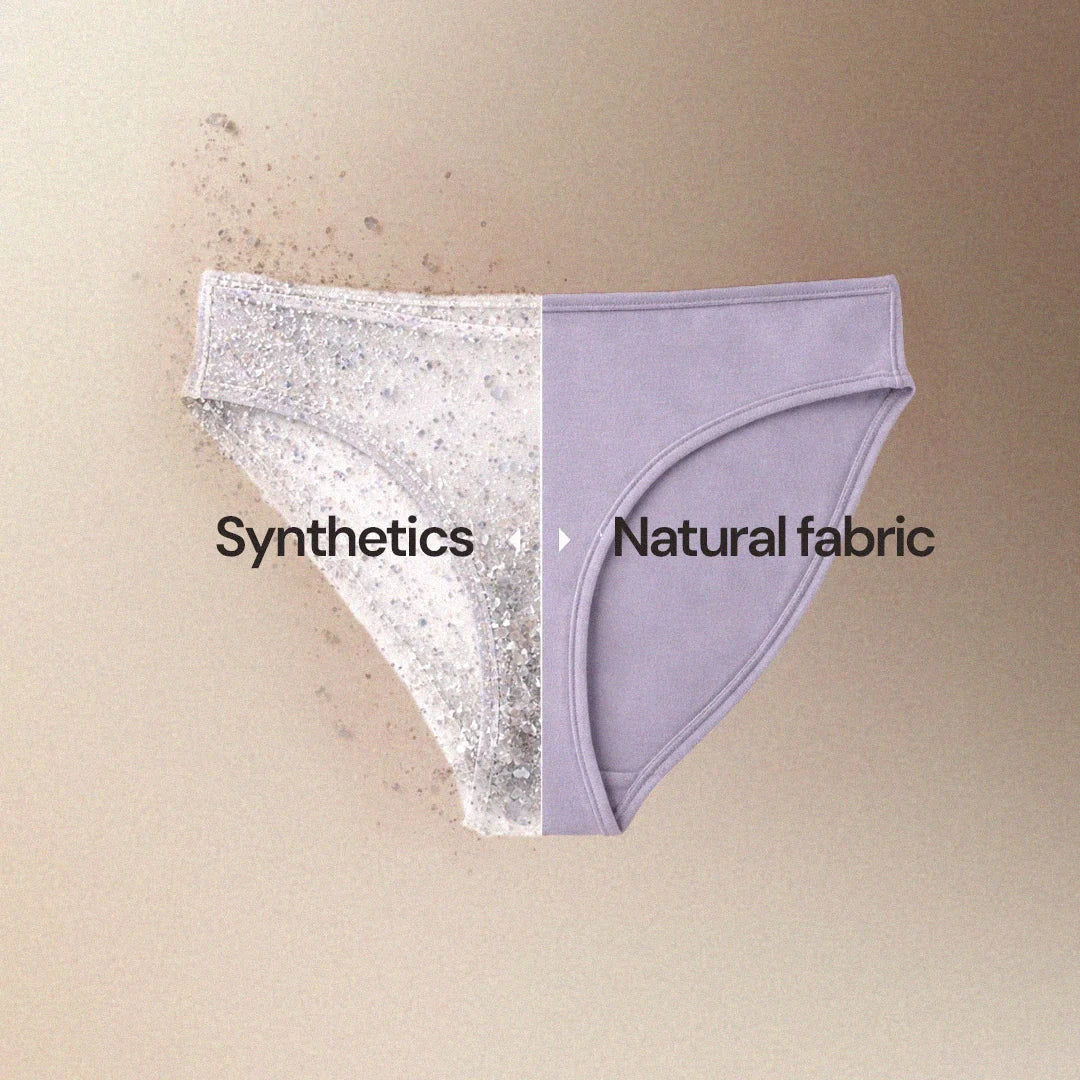
Synthetic fabrics are plastics, softened and colored with chemical additives to make them wearable.
In 2023, the Center for Environmental Health tested polyester and spandex athletic wear - the same materials used in many modern underwear styles. They found Bisphenol A (BPA), a known endocrine disruptor, at levels up to 22 times higher than California’s strict safety thresholds [4].
BPA mimics estrogen in the body. Repeated, low-level exposure matters, especially in areas of high absorption.
What we wear is not just touching us.
It is communicating with our biology.
4. Microplastics, Where We Never Expected Them
Synthetic fabrics are known to shed fibers - over 700,000 microfibers from a single wash [5]. But shedding also happens during wear, through everyday movement and friction.
In 2023, researchers examined uterine tissue from healthy women to see whether these particles could cross biological barriers. Microplastics were found in 100% of samples tested. Thirteen different polymers were identified, including polyamide (nylon), one of the most common materials used in lingerie [6].
This research is still emerging, but it raises important questions about how deeply synthetic materials are embedded - not just in our wardrobes, but in our bodies.
A Small Shift With Meaningful Impact
This information is not meant to overwhelm. It is meant to offer agency.
Unlike air quality or water systems, this is a variable we can change today.
Choosing natural fibers like organic cotton allows the skin to breathe, reduces chemical leaching, and minimizes microplastic exposure. It supports the body’s natural rhythms instead of working against them.
It is a small switch.
But the science suggests it makes a meaningful difference.
At Kiseau, we believe your most sensitive skin deserves the same care as the rest of you. Because what touches your body, touches your health.
Sources
-
Monteiro, M. V., et al. (2013).
Association of sanitary pads and clothing with vulvovaginitis.
Jornal Brasileiro de Doenças Sexualmente Transmissíveis.
https://pmc.ncbi.nlm.nih.gov/articles/PMC8226598/ -
Feldmann, R. J., & Maibach, H. I. (1967).
Regional variation in percutaneous penetration of 14C cortisol in man.
Journal of Investigative Dermatology.
https://pubmed.ncbi.nlm.nih.gov/6073486/ -
Wang, X., et al. (2019).
Widespread occurrence of bisphenol A in daily clothes and its high exposure risk in humans.
Environmental Science & Technology.
https://pubmed.ncbi.nlm.nih.gov/31124657/ -
Center for Environmental Health (2023).
BPA in Sports Bras and Athletic Shirts.
https://ceh.org/yourhealth/bpa-in-sports-bras/ -
Napper, I. E., & Thompson, R. C. (2016).
Release of synthetic microplastic fibres from domestic washing machines.
Marine Pollution Bulletin.
https://www.sciencedirect.com/science/article/abs/pii/S0025326X16307639 -
Ma, C., et al. (2023).
Detection and quantification of various microplastics in human endometrium.
Science of The Total Environment.
https://www.sciencedirect.com/science/article/pii/S0048969723063878
Medical Disclaimer
The information shared by Kiseau is for educational and informational purposes only and is not intended to diagnose, treat, cure, or prevent any disease. It should not be considered medical advice or a substitute for guidance from a qualified healthcare professional. Individual health needs and responses may vary. Always consult your physician or licensed healthcare provider with any questions regarding your health.